PROJECT PRESENTATION
Foaming process in alkali activated matrix and optimization of properties of synthesized foams
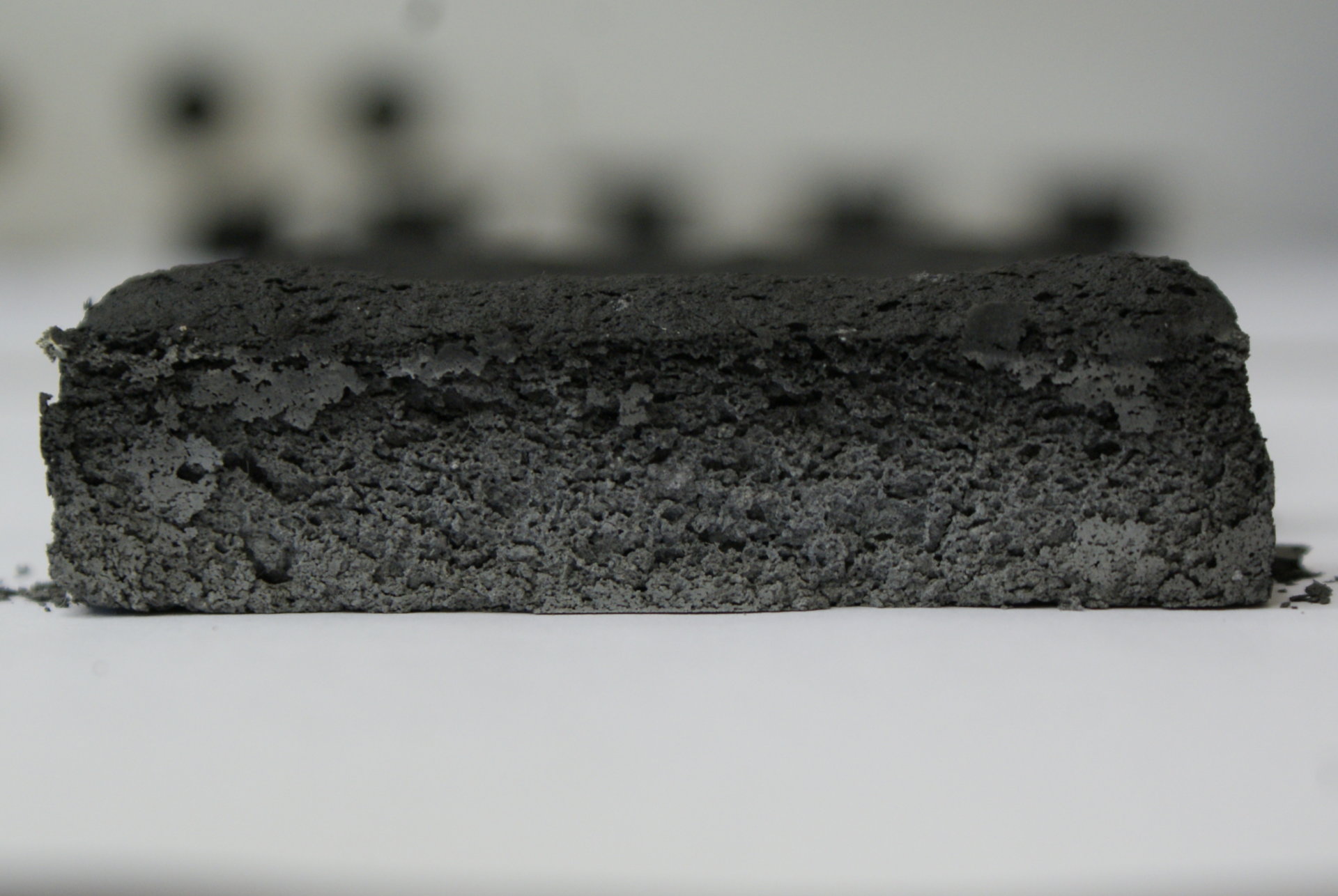
Termit and Slovenian national building and civil engineering institute (ZAG) are researching usefulness of different inert and non-dangerous waste materials, which have after alkali activation high compressive strength – geopolymers. With addition of foaming agents, the compressive strength lowers, but synthesized foams get higher added value due to insulation and non-flammable properties.

- Using waste material instead of raw material
- Lowering the need for new waste dumps
- Lowering of amount of existing waste by turning it into useful material
- Lowering of production energy in comparison to already existing products made from raw materials
- lowering of carbon footprint in comparison to already existing products made from raw materials
- Lowering of production costs in comparison to already existing products made from raw materials
- Comparable or even better properties in comparison to alternative already existing materials made from raw materials
- Possibility of complete immobilization of dangerous materials (chemically and due to the shape) in synthesized products
By increasing the amount of waste materials and reducing available raw materials, construction is geared towards finding new, more environmentally friendly alternatives. Therefore, Termit and ZAG analysed various waste materials: mixture of fly ash and bottom ash from heating plant, foundry sand and slag, ceramics before and after sintering, refractory materials, mineral wool (rock and glass), various sludges, gypsum, etc. Chemical requirements on the precursor used for the alkali activation are to have a significant amount of SiO2 and Al2O3, and less amorphous elements from 1st and 2nd group of the periodic system. On the other hand, mineralogical requirements on the precursor are that there is more amorphous phase than crystalline phase. Waste materials that met the conditions were alkali activated and their compressive strength was tested according to the different preparation methods, input parameters, curing and drying regimes.
It turned out that:
- it is better if in the alkali activation participating particles from the waste material are smaller,
- it is wise to theoretically determine minimum amount of alkali needed in reaction from chemical and mineralogical analysis of precursor, to avoid efflorescence and to reduce costs,
- there can be a big difference in the use of different alkalis, even though all are in the 1st group of periodic system,
- it is wise to mix different wastes to get the appropriate Si:Al ratio, and use in this way also the less suitable materials,
- it is better, if the amount of the liquid phase in the mixture is minimal needed,
- less important if curing is performed at room or at a higher temperature if the ratio of ingredients is correct,
- it is better if drying takes place under milder temperature conditions unless material does not solidify without applying heat,
- it is better if precursor and alkali activated slurry are well homogenized.
Compressive strength of 20 MPa was obtained by using ash, 30 MPa by using foundry sand, 35 MPa by using raw mixture for ceramics, 45 MPa by using slag and 70 MPa by using rock wool. For comparison with our products, Portland cement class 32.5 reaches compressive strength after 28 days from 32.5 MPa to 52.5 MPa. Alkali activated foams were prepared with and without foaming and stabilizing agents. Chemically synthesized foamed materials with density 0.7 kg/l had highest compressive strength higher from 5 MPa, while lowest density reached was 0.3 kg/l.
Use: as insulating and refractory materials in building industry, i.e. for green roofs, exterior linings of furnaces, chimneys in industry, as fillers in fire doors, as fire barriers in tunnels, cultural monuments, facade panel, paving stones etc.
Project No. C3330-17-529032 “Raziskovalci-2.0-ZAG-529032” was granted by Ministry of Education, Science and Sport of Republic of Slovenia. The investment is co-financed by the Republic of Slovenia, Ministry of Education, Science and Sport and the European Regional Development Fund.